
Online Safety
The Tech Support Scam Call: What to Do in the First 5 Minutes
What the fake virus pop-up and the fraud department phone call actually sound like, and the five things to do in the moment if it happens to you.

Online Safety · Blog
The FBI counted every scam complaint Americans 60 and older filed in 2025. The results show which scams deserve your worry first, and the one that gets the most attention is not the one that costs the most.
5 min read Orange County & Laguna Woods
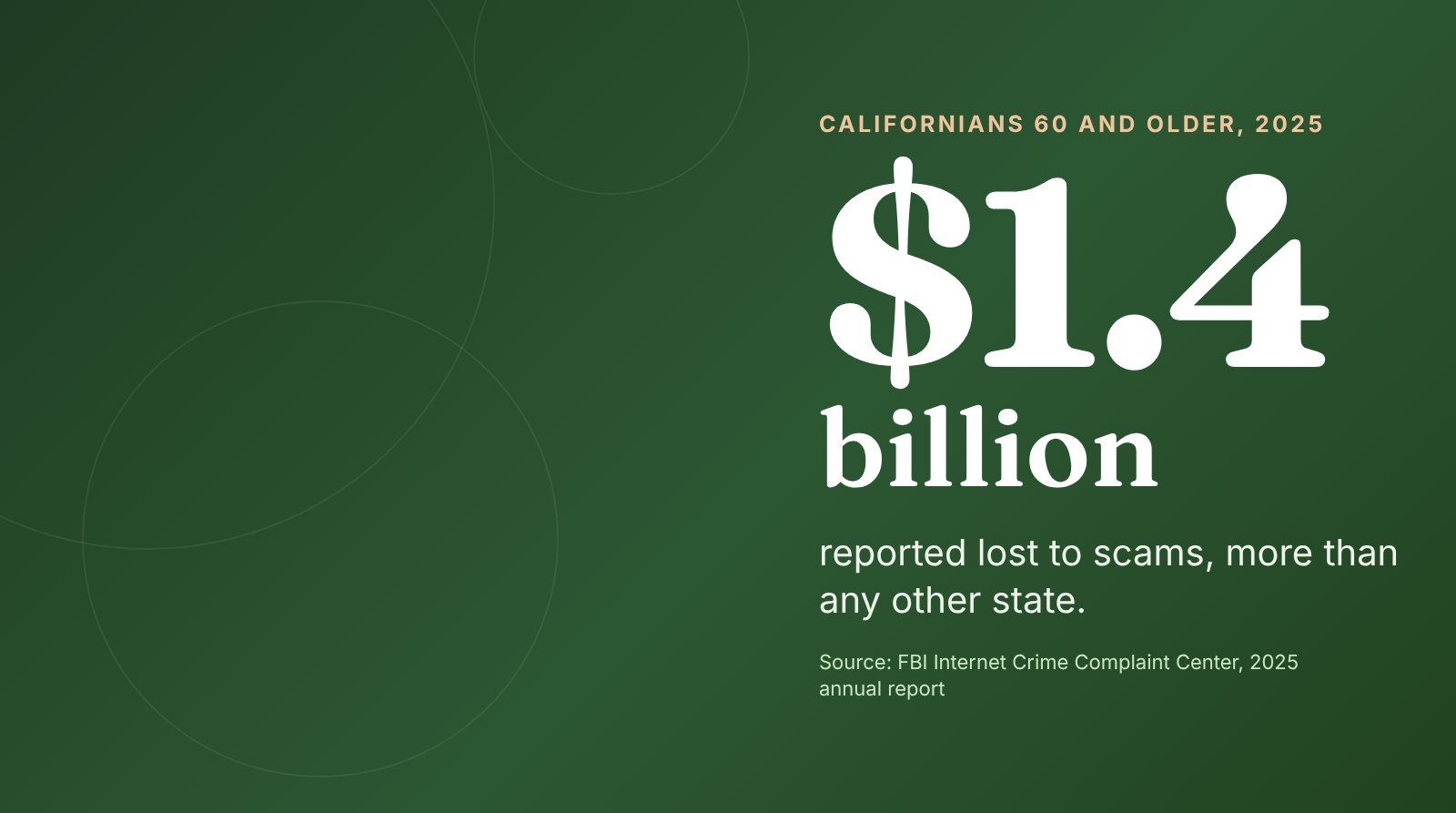
Every year the FBI's Internet Crime Complaint Center publishes what people reported to it. The 2025 report came out this spring, and one number stands out for anyone who lives here: Californians 60 and older reported $1,403,975,911 in losses. That is more than any other state, and nearly double Florida's $709,823,172.
Two honest caveats before we go on. These are reported cases, and federal officials have said that most elder fraud is never reported, so the real totals are probably higher. And the report breaks results out by state, not by county, so we can't give you an Orange County figure.
Here are the biggest categories for people 60 and older, ranked by dollars lost.
Business email compromise, a business payments scam, also ranked in the top five at $568 million, so we left it out of the list. By sheer count, the most common complaint was phishing and spoofing, the fake text or email that looks like your bank or a delivery company: 48,064 complaints.
Now the scam that gets everyone talking. The FBI counted 3,143 complaints from people 60 and older that involved AI, with $352,496,231 in losses. AI shows up inside many kinds of fraud, including fake investment videos, so that is not a voice clone total. For "distress" scams, the family emergency calls, the report puts losses across all ages at just over $5 million.
That is small next to $7.7 billion, and we would rather tell you that than scare you. The call still deserves a plan. It is the one scam that borrows the voice of someone you love, and it is built to make you act before you think. A short family conversation shuts it down. We walk through it in our post on AI voice cloning and the family code word.
People 60 and older filed 6,188 complaints involving crypto kiosks, the "Bitcoin ATMs" often found in convenience stores and gas stations, with reported losses of $257,466,130. California caps what a customer can put through a kiosk at $1,000 per day, according to the state's Department of Financial Protection and Innovation.
Our rule is simpler. No bank, agency, company or family member needs you to pay through a crypto kiosk. If someone sends you to one, stop and call someone you trust.
Free printable
One page, large print, free. What to do when the call comes, who to call first, and where to report a scam.
Also free: the Is It a Scam checklist (PDF) and more on our free guides page.
Act quickly, and don't be ashamed. These scams are run by professionals, and sharp people get caught. Call your bank or card company first. Then report it to the FBI at ic3.gov, to the FTC at ReportFraud.ftc.gov, and to the National Elder Fraud Hotline at 1-833-372-8311, a free Justice Department service for people 60 and older. The Justice Department says hotline staff can help you file an FBI report, and that a report has the potential to freeze funds, though that can't be guaranteed.
If passwords or devices were involved too, start with our hacked device recovery plan.
We are not a fraud agency, and we can't get money back. What we can do is sit down with your family, in person, and make the habits above stick: set up the code word, show you what a fake pop-up or text looks like on your own phone and computer, and make sure everyone knows who to call first. See how a visit works.
Ready When You Are
Call or email, tell us what's giving you trouble, and we'll take it from there. No pressure, and no obligation.
(949) 994-2407Keep reading
Online Safety
What the fake virus pop-up and the fraud department phone call actually sound like, and the five things to do in the moment if it happens to you.

Online Safety
A scammer only needs a few seconds of your grandchild's voice to make a call that sounds completely real. Here is the one free habit that shuts it down.

Online Safety
When it feels like everything is on fire, here's the exact order to do things in, and why it matters.